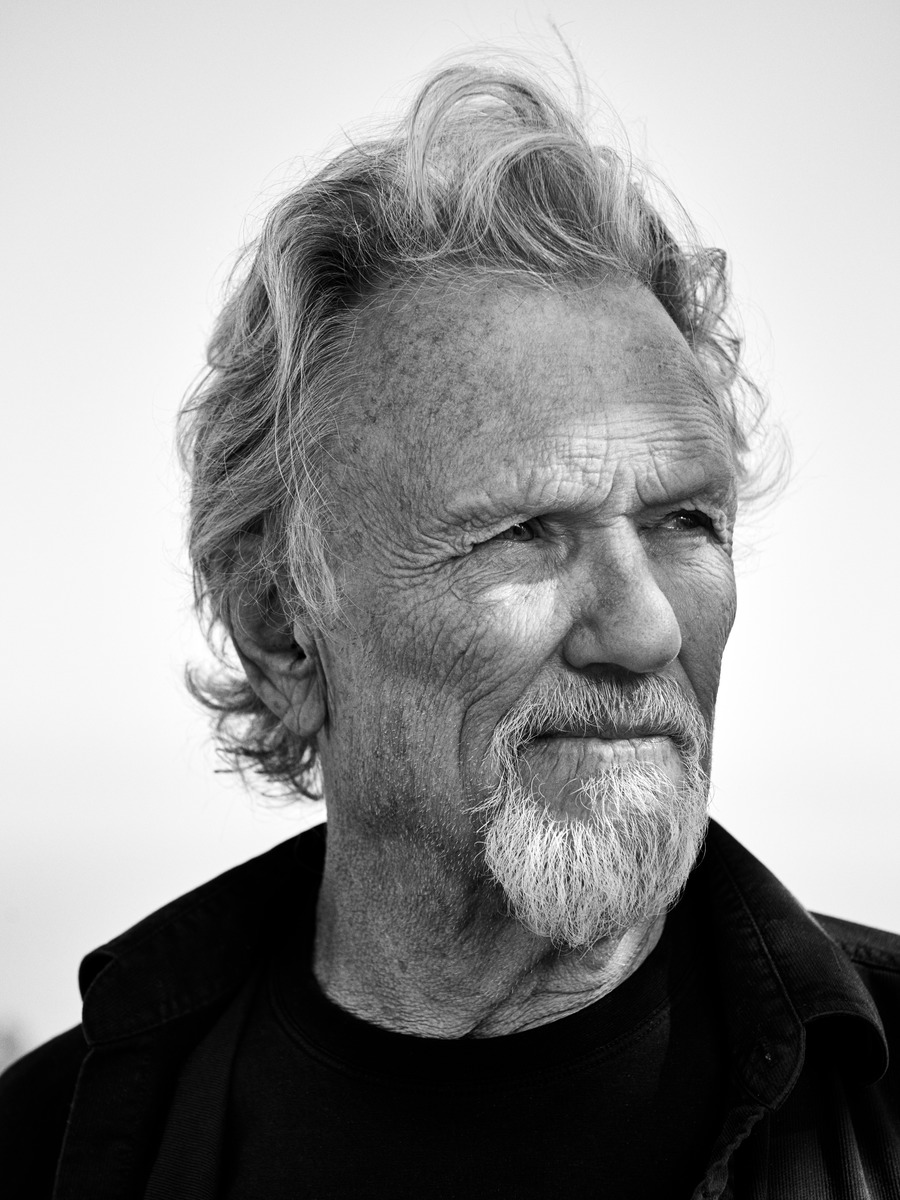
Artist, singer, songwriter, actor and activist Kris Kristofferson passed away peacefully in his home in Maui, Hawaii Saturday, September 28, surrounded by family. He was 88 years old.
Born Kristoffer Kristofferson in the border town of Brownsville, Texas on June 22, 1936, Kristofferson changed the language of country music, with extraordinary internal rhymes, Shakespearean iambic pentameter, and socially progressive subject matter that found the personal within the political.
He was a Rhodes Scholar in Oxford, a defensive back, a bartender, a Golden Gloves boxer, a gandy dancer, a forest firefighter, a road crew member, and an Army Ranger who flew helicopters. He was a peacenik, a revolutionary, an actor, a superstar, a sex symbol, and a family man. He was commissioned to teach English at West Point, though he gave that up to become a Nashville songwriting bum.
Sam Peckinpah cast him as Billy the Kid. Willie Nelson recorded an entire album of his songs, then joined him in supergroup The Highwaymen, with Johnny Cash and Waylon Jennings. Muhammad Ali sat side-stage at his concerts. Mama Cass Elliot called him “No Eyes.” Atlantic Monthly published his short stories.
He believed that songwriting is a spiritual communion of mind, body, and soul, and he believed that William Blake was correct in asserting that anyone divinely ordered for spiritual communion but buries his talent will be pursued by sorrow and desperation through life and by shame and confusion for eternity.
“(Blake) is telling you that you’ll be miserable if you don’t do what you’re supposed to do,” Kristofferson said in the Ken Burns’ documentary Country Music.
Kristofferson’s devotion to spiritual communion brought much in the way of sorrow, desperation, and misery, but it led to triumph.
His work ethic was evident from an early age, celebrated by his parents and, when he was a teenager, a construction supervisor on Wake Island said he was the best worker on the construction crew.
“I took pride in being the best laborer, the guy that could dig the ditches the fastest,” he said. “Something inside me made me want to do the tough stuff . . . Part of it was that I wanted to be a writer, and I figured that I had to get out and live. I know that’s why I ran in front of the bulls in Pamplona.”
The son of a major general and a philanthropic mother, Kristofferson spent his childhood learning lessons in honor and civility, though he arrived at different notions of these things than did his parents. He graduated high school in San Mateo, California, in 1954, then attended Pomona College, where he played football (“I was pretty slow, but I was small,” he said) and studied writing under Dr. Frederick Sontag, who pushed him to apply for a Rhodes scholarship. At Oxford, he wrote stories and examined the works of William Blake.
Kristofferson earned his master’s from Oxford in 1960, then returned to California, married his high school sweetheart, joined the Army, and learned to fly helicopters. In the Army, he wrote funny songs inspired by Hank Williams, until he fell under the sway of folk maestro Bob Dylan.
“The direction Dylan was pointing in made it a respectable ambition, a respectable thing to do,” Kristofferson said.
The Army assigned Kristofferson to teach literature at West Point, a duty that frightened him once he found that he’d have to turn in lesson plans, explaining to superiors exactly what he’d be teaching in class. He said, “It sounded like hell to me.”
And so, in 1965, he came to Nashville to visit with Marijohn Wilkin, the songwriter of “Long Black Veil” and a relation of Kristofferson’s Army platoon leader. On Kristofferson’s first Nashville night, he met Cowboy Jack Clement, a renegade creative who would become a lifelong friend. Soon after that, Wilkin helped Kristofferson get a backstage pass to the Grand Ole Opry, where he met a pacing panther named Johnny Cash. In less than two Music City weeks, Kristofferson decided to resign his Army post and move to Nashville to write songs. Soon after, he met successful songwriter Tom T. Hall in a Nashville bar. Kristofferson introduced himself to Hall, who said “Good to see you . . . It’s a hairy-legged town.”
Kristofferson scuffled for more than four years in Nashville, entering his 30s as what his parents considered a ne’er do well who was dragging down the family name. He worked as a janitor at CBS’s Nashville studio, happy to empty trash cans and make coffee in exchange for access to recording sessions by Johnny Cash, Bob Dylan, and others. He rode around on a well-bruised Honda motorcycle, and neglected family matters in ways that came to haunt him and that doomed his first marriage. He was heartened by praise from the people whom he hoped would become peers. When his “From the Bottle to the Bottom” was recorded by Grand Ole Opry star Billy Walker in 1969, Tom T. Hall said, “God, that’s a great song” and quoted lines back to the fledgling talent.
“That kind of thing was enough to keep me going back then,” Kristofferson said.
After more than four years in songwriting purgatory, things began to roll Kristofferson’s way. Ray Stevens recorded his “Sunday Mornin’ Comin’ Down,” and Johnny Cash recorded the same song and took it to the top of the country charts. Cash performed “Sunday Mornin’” on his ABC television show, and, despite the cries of network censors, refused to change Kristofferson’s line “Wishing, Lord, that I was stoned” to “Wishing, Lord, that I was home.” That song was voted the Country Music Association’s song of the year in 1970.
Roger Miller, one of Kristofferson’s songwriting heroes, recorded “Me and Bobby McGee,” a song inspired by publisher and Monument Records boss Fred Foster’s suggestion that a song should be written about Foster’s secretary, Bobby McKee. And Kristofferson’s “For the Good Times” was recorded by the great Ray Price and became a No. 1 country hit.
After arguing with Foster about his validity as a recording artist (Kristofferson said, “I sing like a fucking frog,” to which Foster replied, “Yes, but like a frog that can communicate.”), Kristofferson’s first solo album came out in April of 1970. It contained now-classics including “Sunday Mornin’ Comin’ Down,” “Me and Bobby McGee,” “To Beat the Devil,” “Help Me Make It Through the Night,” “Just the Other Side of Nowhere,” “Darby’s Castle,” and “Best of All Possible Worlds.” It began with “Blame It On the Stones,” a song that opened with the decidedly non-traditional line, “Mr. Marvin Middle Class is really in a stew/ Wonderin’ what the younger generation’s coming to.”
With that debut album, Kristofferson emerged as a luminous figure whose fame expanded far beyond country music. Janis Joplin recorded “Me and Bobby McGee,” which became her signature hit. And Kristofferson became a counter-culture darling, beloved by artists and listeners who had never before paid attention to country music.
“You can look at Nashville pre-Kris and post-Kris, because he changed everything,” said Bob Dylan.
Kristofferson’s second album, The Silver Tongued Devil and I, came out on Monument Records in 1971 and contained “The Pilgrim – Chapter 33,” a song he claimed to write about friends Cash, Chris Gantry, Funky Donnie Fritts, and others but later admitted was mostly about himself. “He’s a walkin’ contradiction, partly truth and partly fiction,” he sang. “Taking every wrong direction on his lonely way back home.”
All those wrong directions led to some spectacular locales. In 1971, Kristofferson began a side career as an actor. He would go on to win a Golden Globe award for his role in A Star Is Born, and to act in numerous films including Semi-Tough, Songwriter, Pat Garrett and Billy the Kid, The Sailor Who Fell from Grace with the Sea, Lone Star, and Blade. He toured the world with his band and with Rita Coolidge, his wife from 1973 until 1980. He moved from Nashville to California. And he released seven solo albums between 1972 and 1979.
This flurry of activity and the accompanying celebrity did not ease Kristofferson’s mind, which was prone to depression, or his problematic drinking habit. The heady years of grand success proved to be some of the most difficult of his life.
“The darkness is driving me farther away from the shore/ Throw me a rhyme or a reason to try to go on,” he wrote and sang in “Shipwrecked in the 80s.” He found rhyme and reason in the graceful form of Lisa Meyers, who married Kristofferson in 1983 and helped him get his life under control. The couple would have five children together.
In 1985, Kristofferson joined Cash, Waylon Jennings, and Willie Nelson to form the supergroup now called The Highwaymen. The group returned Kristofferson’s voice to radio, provided a larger audience for him to relay his critical and sometimes controversial views on American foreign policy, and offered him great joy.
“Every time I look at a picture of Willie and me and John and Waylon, I find it amazing that they let the janitor in there,” he told journalist Mikal Gilmore.
After two roundly ignored solo albums for Mercury Records, Repossessed and Third World Warrior, Kristofferson began working with producer Don Was in 1995. Their creative partnership proved fruitful, with Was’ restrained production allowing the gristly character in Kristofferson’s voice to be heard to full effect, and with Kristofferson writing pensive, eloquent songs that rank with his finest works. “It’s about making sense of life at this end of the game,” Kristofferson said about his 2009 Closer to the Bone album, and that comment also applies to Was-produced works A Moment of Forever (2006), This Old Road (2009), and Feeling Mortal (2013). On his 80th birthday in 2016, Kris released The Cedar Creek Sessions, which was nominated for a Grammy for best Americana Album six months later.
Until the pandemic in 2020, Kristofferson toured incessantly in the 21st century, a quiet man in worn brown boots, commanding stages with only his guitar and harmonica for accompaniment. His Gibson acoustic might go out of tune . . . no matter. In his final years he performed with Merle Haggard’s band, The Strangers.
In 2003, Kristofferson received the Free Speech Award from the Americana Music Association and in 2004 he became a member of the Country Music Hall of Fame. Since then, he received lifetime achievement honors from BMI, The Recording Academy, the Country Music Association and the Academy of Country Music, among many others.
“When I got started, I was one of the people hoping to bring respect to country music,” he said. “Some of the songs I had that got to be hits did that. I imagine that’s why somebody might vote me into a Hall of Fame. I know it’s not because of my golden throat.”
On the back cover of The Silver Tongued Devil and I, Kristofferson advised that his songs were “Echoes of the going ups and coming downs, walking pneumonia and run-of-the-mill madness, colored with guilt, pride, and a vague sense of despair.”
Sometimes divine communion, then, is holy hell. Kristofferson brought some of that hell on himself, and he lived through times when guilt and despair were anything but vague, and when pride was hard to conjure. Asked about regrets, he said, “Listen, I have those. But my life has turned out so well for me that I would be afraid to change anything.”
Kristofferson’s survived by his wife, Lisa; eight children, Tracy, Kris Jr., Casey, Jesse, Jody, John, Kelly, and Blake; and seven grandchildren, who offer the following consolatory statement:
“It is with a heavy heart that we share the news our husband/father/grandfather, Kris Kristofferson, passed away peacefully on Saturday, September 28 at home. We’re all so blessed for our time with him. Thank you for loving him all these many years, and when you see a rainbow, know he’s smiling down at us all.” – The Family of Kris Kristofferson
The family asks for privacy during this time.





















 Whitetail Season is Here - Save up to 33% at Cabela's!